What AI tells shoppers about 100 products.
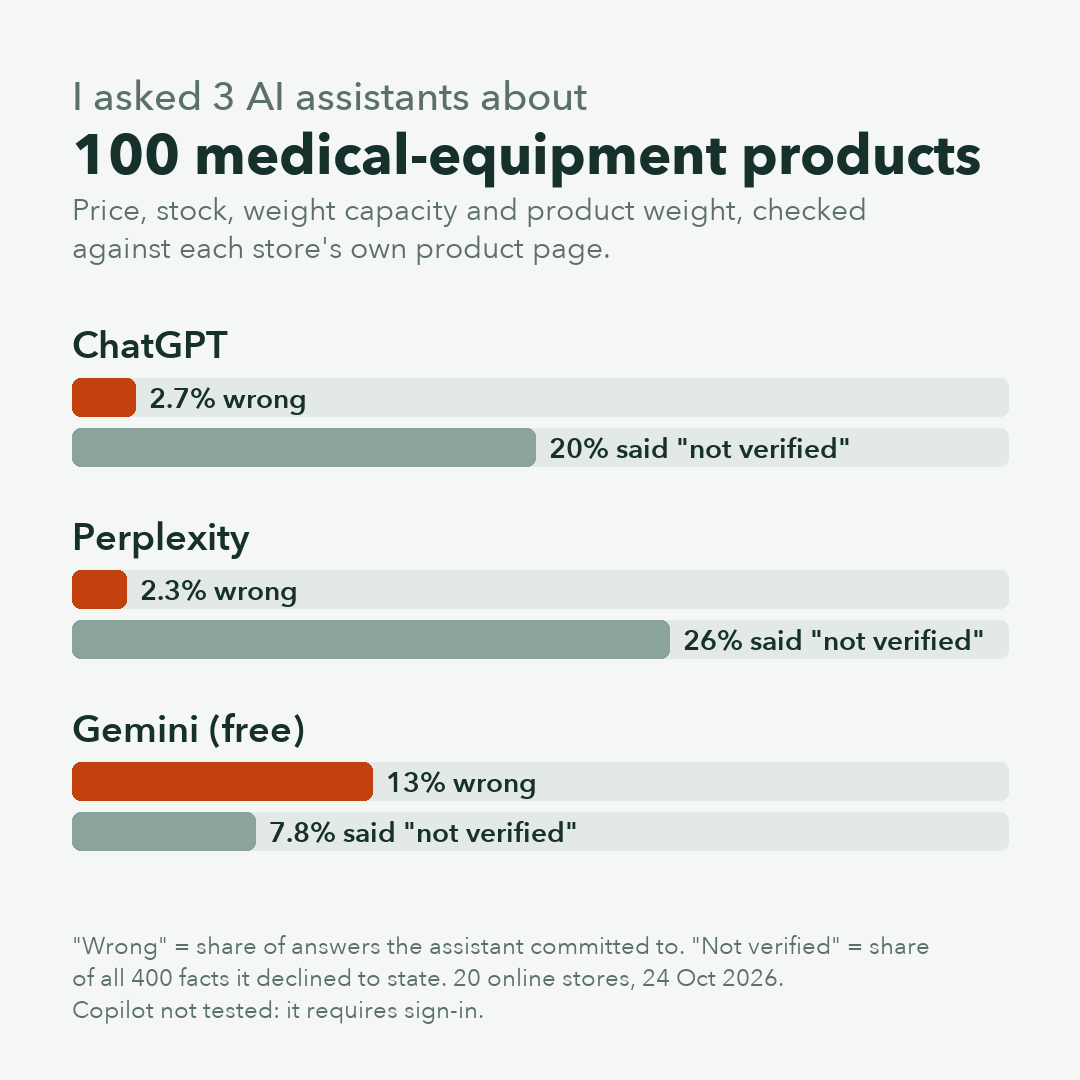
We asked ChatGPT, Perplexity and Gemini what a caregiver would ask about 100 products from 20 online medical-equipment stores: price, stock, weight capacity, product weight and the return policy. Then we checked every answer against the store's own pages.
1,200 product facts and 60 return policies
| Assistant | Wrong (of answers it committed to) | Said "not verified" (of 400 facts) |
|---|---|---|
| ChatGPT (signed in, web search on) | 2.7% | 20% |
| Perplexity (signed out) | 2.3% | 26% |
| Gemini (free, signed out) | 12.8% | 8% |
| Copilot | Not tested: it requires sign-in | |
Errors are rare with web search on
ChatGPT and Perplexity got under 3% of the facts they stated wrong. Most of those errors were stock status.
Hedging is the bigger problem
They said "not verified" on 1 in 5 to 1 in 4 facts, mostly stock and specs. When AI can't read your page, it won't recommend you with confidence.
Free Gemini guesses
It priced a $725.99 patient lift at about $355 and said a walker rated for 600 lb holds "400–500 lbs". In this category a wrong weight limit is a safety problem.
The stores' own pages
Two policy pages that disagree
One store's refund policy says 30 days; another page on the same site says 15. Two assistants told shoppers 15. A second store lists a 20% restocking fee in one place and 15% in another.
Hidden "Out of stock" text
Product pages carried "Out of stock" and "Currently unavailable" in template code shoppers never see. ChatGPT read it and called five in-stock products unavailable.
Two products, one name
Two listings with the same title, different prices and weights. Each assistant picked a different one.
Two weights on one page
16.5 lb in the description, 11 lb in the spec table. The assistant reports both, and the shopper trusts neither.
"Sale" and "Sold out" together
A $2,000+ power chair page showed both labels. Perplexity told shoppers it was sold out; it was in stock.
Near-duplicate listings
One store had about 60 near-identical listings, which gave assistants several conflicting answers to choose from.
Five checks you can run yourself
Ask an assistant
Ask ChatGPT, Perplexity and Gemini about your three best sellers and compare each answer with your product page.
One policy page
Keep returns, refunds and restocking fees on one page and link to it everywhere else.
Search your templates
Look for "Out of stock" or "Sold out" text in your theme that shows on every page, even when hidden.
Unique titles
Give every product a distinct title, and merge or redirect near-duplicate listings.
One set of specs
Make the description and the spec table agree on weight, capacity and dimensions.
How the check was done
20 online stores selling home medical and mobility equipment (18 US, 2 UK), all on Shopify, with 17 to 9,848 products each. Five products per store, 100 in total. The truth for each fact came from the store's own product data and policy pages on 24 October 2026. Each assistant got one shopper-style prompt per store, in a new chat. Answers were matched with small tolerances (price ±1%, capacity ±3%, weight ±6%) and every mismatch was reviewed by hand.
Limits: one prompt covered five products at once, which is less natural than asking about one product. Copilot wasn't tested. Assistants change often, so these results describe October 2026. Stores aren't named in this report.
Ready to see what AI is telling your customers?
Tell me your store and one product. I'll check it across ChatGPT, Perplexity and Gemini and reply within two business days with what I found.